The Design Process: Case Study

Essays, Project Case Study, Uncategorized

Every designer will have a design process that they use to produce their best quality work. I will explore the design processes as commentated by Karl Aspelund, Nigel Cross and Anastasia Prokhorova. Karl Aspelund’s design process describes a common design process used by many graphic designers, architects and interior designer. Nigel Cross describes the design processes from an engineering context and Anastasia Prokhorova depicts the design process of many UX designers. It is interesting to note the similarities and differences of each of the design processes, as well as noting how the processes overlap. 

Karl Aspelund:

Karl Aspelund describes his theory of the design process as a seven-phase process. Aspelund maps out the design process as inspiration, identification, conceptualisation, exploration/refinement, definition/modelling, communication and production. 

Inspiration

Inspiration should be a key part of every designer’s process, it is where initial ideas start forming and the designer is able to begin to envision a solution. Aspelund identifies that inspiration is a crucial part of the design process however, ‘it is a tool that furthers designs; it is not an end in itself’ (Aspelund, 2010). Aspelund expresses that without inspiration a designer can too easily focus too closely on one idea without noticing valuable and effective ideas. This can be dangerous for the designer as the designer should be ‘continually on alert for new stimulations, new challenges and new approaches to old problems’ (Aspelund, 2010). The reason that inspiration cannot be the most important part of the design process is that design ‘involves a need to go beyond [inspiration] and use an idea and the philosophizing surrounding it to create something else: a product that is physical, useful and more than just an expression of a concept’ (Aspelund, 2010.

Identification

The identification phase of the design process is where the constraints of the project are considered. Every project will contain constrains, whether they may be imposed by the client, yourself, the time to complete, available resources and budget. These constraints will then form the project brief. ‘A project’s needs and limit’s are it’s constraints, and by identifying them, we understand what we need to engage with to create an effective design,’ (Aspelund, 2010). Aspelund identifies that ‘the best way to recognize a designs inherent constraint is by questioning whether the object would lose its essential nature if a certain aspect were to be removed,’ (Aspelund, 2010). The identification stage is crucial to the success of the designer and the design as ‘a designer’s main concerns are solving problems and making decisions’ (Aspelund, 2010), without identifying the constraints there are no problems to solve, nore decisions to make. 

Common Constraints:

End User Constraints are constraints that directly affect the end user. These often include the safety of the product or design and should also include the functionality and form of the product as well as societal constraints. 

Constraints of Production are the limits as a result of production materials and processes available. These will often include software such as Adobe and CAD modelling programs. It will also depend on the materials available as well as techniques that can be used. The capabilities of all involved in the process (human and machine resources) is also a constraint to the design process. 

Constraints of the Designer must also be considered. The constraints on the designer include the information that is available to them, the time they must design the product. The materials and budgets available are also constraints on the designer.

Constraints of Responsibility include the designer’s responsibility to plan for unexpected outcomes as well as planning for sustainability. It is important that the designer considers how to use resources most efficiently. The designer should work to increase durability, reuse and reparability. The designer may also consider how they can help with changing the relationship between developed and developing countries.

Conceptualisation

In order to bring an idea from a vision to a tangible concept the designer must work to refine their idea. Aspelund states that a good way to refine this idea is to ask, ‘how can you explain this idea further, so that your clients, fellow designers and production team can understand and relate to what you are thinking?’ (Aspelund, 2010). The design stage of conceptualisation involves growing your understanding of the idea ‘to the point where you know as clearly as possible what it is and how it behaves’ (Aspelund, 2010). 

Exploration / Refinement

Aspelund includes this phase of the design process as he describes that every ‘concept for a design contains many unexplored possibilities; and these possibilities should always be explored, no matter what the outcome.’ (Aspelund, 2010)It is important not to remain convinced of one idea, rather all possible solutions should be explored before the best is chosen. This stage also ‘allows you to question the viability of your concept by testing the imagined elements involved against reality’ (Aspelund, 2010). You should also start refining the best concepts so that it is possible to see how they would work as the final product. 

Definition / Modelling

The definition and modelling phase is when the concepts begin to look like actual products. It is also important to consider a ‘hierarchy of needs’ (Aspelund, 2010) in order to decide which parts of the design are more necessary to the end solution than others. This is necessary as there are usually more limitations when creating the model than there were when thinking of a concept. The modelling of a concept can also be a good tool for further exploration of ideas as many designers will learn by doing, and by making the model in its actual form, many designers will continue to think of improvements. 

Communication

Throughout the design process it is important that the designer can clearly communicate ideas. However, at this stage it is especially important that the designer is able to clearly and effectively communicate their ideas as they will need to convince others about the success of the design. Common audiences at this stage are ‘clients, corporate officers, production staff and fellow designers’ (Aspelund, 2010). 

Clients

It is important to respond to the needs of the clients, as this is who prompted your design. However, you don’t need to follow the exact requests of the client, but you should absolutely respond to them. The client may identify an issue, and you may find a solution that fixes that issue, but also others. The client may be right, but that doesn’t mean you should stop exploring other solutions. Mark Zeff, president of Zeff Design, based in New York and working in multiple fields including architecture, interior design, furniture, graphics, product design and marketing, says that ‘probably the most important component in the design world is the ability to communicate with your client and hear what the client wants.’ (Mark Zeff cited in Aspelund 2010). 

Corporations

When designing for a corporation, ‘the levels of communication increase dramatically’ (Aspelund, 2010). Generally there are many more key stakeholders who each have their own agenda for what they want for the product. It is necessary to communicate to and consider each of these perspectives. In this space it is imperative that you make sure that you communicate effectively and clearly with all stakeholders, and that you do not miss any key communication. 

Manufacturing

It is important that as the designer you can clearly communicate the product to the manufacturer. Ultimately it is the manufacturer who will create your product in the form it will enter the market, so it is of upmost importance that you can communicate the needs of the product to them. If you don’t communicate this effectively the manufactured version of your product may look very different to what you had in mind. 

Production

This is the stage of the design process when the designer will be working the closest with the manufacturing teams. It is important that the designer can ‘see the benefit of feedback’ as the ‘production team has knowledge and expertise that the designer can make the most of’ (Aspelund, 2010). It is important to build multiple prototypes so that you can best understand how the product will interact. It is also important that you keep to a defined schedule to ensure the product can be delivered within the set timeframe and do not hold others up. This is the final stage of the design and will see your product find its way into the hands of consumers. 

Nigel Cross – Study of how designers work

Cross studies how designer’s work, especially in comparison with other problem-solving fields such as science and engineering. He found that after studying some of Bryan Lawson’s studies that ‘scientists problem-solve by analysis, whereas designer’s problem-solve by synthesis’ (Cross, 2006). Lawson (2005) described ‘scientists as having a problem-focused Lawson (2005) described ‘scientists as having a more problem-focused strategy and the architects as having a solution-focused strategy.’ Cross (2006) suggests that this is way of thinking is most likely as a result of the respective education programs as Lawson conducted more experiments with first year and high school aged students and these differences did not appear. 

Cross also suggests that the difference in the ways of thinking occurs out of the necessity for the type of problems that designers and scientists would need to solve. Generally designers problems are more ‘ill-defined, ill-structured or wicked’ (H Rittel, 1973) as opposed to scientists and mathematicians where all the ‘necessary information …is available to the problem-solver.’ (Cross, 2006) Therefore, the designer must know how to re-format and re-define the problem until they can find a solution, this can be ‘the most challenging and difficult part of designing.’ (Jones, 1970). 

There are three design processes that Cross identifies as being most commonly followed by designers and engineers. The first is the ‘systems approach,’ which is followed mostly by innovators. The second involves ‘framing the problem in a distinctive and sometimes personal way,’ (Cross, 2011). The third process involves ‘designing from ‘first principles’ (Cross, 2011). 

Systems Approach

The systems approach is adopted mainly by innovators as ‘the innovator has a systems mind, one that sees things in terms of how they relate to each other introducing a result,’ (Maccoby in Cross 2011). It was found that designers who followed a ‘flexible-methodological procedure tended to produce good solutions’ (Fricke, 1993 cited in Cross, 2006‘) It is common that designers who use this approach will spend a lot of their time analysing the problem in search for a solution. (Also check out this article by Janan Mustafa, An Exploratory Study for the Role of System Mind in Creative Design Thinking)

Framing Approach

Many designers explore a problem from a particular perspective ‘in a way that stimulates and pre-structures the emergence of design concepts,’ (Cross, 2011). Often this framework will come from the ‘requirements of the particular design situation, but is strongly influenced by their personal motivations,’ (Cross, 2011). Cross represents these approaches in the context of race car design, where the designer may be focused on ‘providing pleasure for the product user, or competitively achieving the fastest car despite regulations.’ (Cross, 2011)

A designer who used this approach was Victor Scheinman, as demonstrated in the ‘Delft Design Protocols Workshop (Cross, 1996 cited in Cross, 2006). Here, Scheinman had to think aloud his design process for the design of a clip to attach a backpack to a mountain bike. It is evident how he framed the problem using his own personal experiences of riding mountain bikes as a kid. Rather than solving the problem from the perspective of simply attaching the backpack to the bike in a static scenario, he considered the issues he had found with the instability caused by a backpack with a high centre of gravity on the wobbly mountain bike trails. By simply framing the problem using his own experiences he was closer to making a more effective solution. It is still of importance to understand user feedback in order to design with empathy, but if it is possible to relate an experience of your own to a problem, it is much easier to begin the process of understanding and analysing the problem.  

First Principles

This approach closely follows key fundamental design principles such as ‘form follows function’, where the highest priority is to perfect the function and usability of the product and the form that this will take will follow.  Engineer, Gordon Murray, stresses the need to design from first principles in his context of race car designing. He sees the importance of viewing the yearly iterations of race car designs as a need to go back to what they want the car to be able to do, not just looking at what worked (or not) the previous year. Whilst it is necessary to understand what did and didn’t work on the previous car, the design team should be looking at what it is that they ultimately want the car to be able to do. 

Anastasia Prokhorova and the UX design Process

The UX design process involves a variety of phases with steps that need to be completed for each one. Prokhorova suggests that these phases are Research, Defining and Analysis, Sketching and Wireframing, and UI design, Prototyping and Animation. (Prokhorova, 2019)

Research

The research stage involves the study of the problem as well as the users. It is important that this stage is completed as it is what will ensure that the end result provides the best solution to the design problem. It is also important to research and understand the user. If the designer proceeds with the design of a solution without first understanding the end user, the design solution will most-likely be ill-fitted for the scenario.

Defining and Analysis

In this phase of the design process the problem is defined as a result of the research in the previous stage. The design team will also create personas to represent the users using these personas the design team will then create scenarios and storyboards which will help them to understand the problem from a user’s perspective. 

Sketching and Wireframing

Once the research and definition stages are completed the designer will begin sketching possible designs. The process of sketching the designs allows the designer to translate their ideas into images quickly, allowing for many more possible ideas to be drawn in a short space of time. 

Once the designer has some designs that they are happy with they will then begin creating wireframes using a computer application.

UI design, Prototyping and Animation

The final stage of the UX design process according to Anastasia Prokhorova is to complete the UI (user-interface) design and to prototype the designs. This will allow for testing of the design to receive user feedback.  

Throughout this study of the design processes used by a number of design disciplines it is interesting to see how the processes place a different emphasis on different part of the process. It is also worth noting that each design process tends to follow a similar structure even across the differing disciplines.  

About IDEO’s Open Innovation Practice – OpenIDEO.

DiscoverDesign Handbook. DiscoverDesign.

AHLBERG, P. 2016. Please make this look Nice – The Graphic Design Process, United States of America, Skira Rizzoli Publications.

ASPELUND, K. 2010. The design process, China, Fairchild Books.

CHAN, J., DOW, S. P. & SCHUNN, C. D. 2015. Do the best design ideas (really) come from conceptually distant sources of inspiration? Design Studies, 36, 31-58.

CROSS, N. 2006. Designerly Ways of Knowing, Germany, Springer.

CROSS, N. 2011. Design Thinking, New York, Berg.

FRICKE, G. Empirical Investigations of Successful Approaches When Dealing With Differently Precised Design Problems.  International Conference on Engineering Design ICED93, 1993 Heurista, Zürich.

FRICKE, G. 1996. Successful Individual Approaches in Engineering Design. Research in Engineering Design, 8, 151-165.

H RITTEL, M. W. 1973. Dilemmas in a General Theory of Planning. Policy Sciences, 4, 155-169.

JONES, J. C. 1970. Design Methods, Chichester, UK, Wiley.

LAWSON, B. 1979. Cognitive Strategies in Architectural Design. ERGONOMICS, 22, 59-68.

LAWSON, B. 2005. How Designer’s Think, Architectural Press.

MUSTAFA, J. 2017. An Exploratory Study for the Role of System Mind in Creative Design Thinking. International Journal for Infonomics, 10, 9.

PROKHOROVA, A. 2019. What is the design process? and why every designer should know about it [Online]. Available: https://uxdesign.cc/what-is-the-design-process-and-why-every-designer-should-know-about-it-baab017eed82 [Accessed 7 April 2020].

ROY, R. 1993. Case studies of creativity in innovative product development. Design Studies, 14, 423-443.

SUNG, E. & KELLEY, T. R. 2019. Identifying design process patterns: a sequential analysis study of design thinking. International Journal of Technology and Design Education, 29, 283-302.

SZALAPAJ, P. 2005. COntemporary Architecture and the Digital Design process, Netherlands, Architectural Press.

VAN DOOREN, E., VAN DORST, M., ASSELBERGS, T., VAN MERRIENBOER, J. & BOSHUIZEN, E. 2019. The tacit design process in architectural design education. Design & Technology Education, 24, 79-100.

Booklet Design: Klim Type Foundry Case Study

Project Case Study

Recently, I designed a 12-page booklet studying the work of Klim Type Foundry. This was done for an assessment at uni. The brief was that we must design and layout a booklet showcasing the work of a type designer. I thoroughly enjoyed this project. After my initial research of Klim Type Foundry I knew that I wanted to design a classy, elegant and minimalistic booklet. I felt that this would strongly resonate with Klim’s style.

Klim type foundry is a New Zealand based type foundry, operated by Kris Sowersby. They have designed many fabulous typefaces, however I chose to focus mainly on the Domaine font foundry. (I would highly recommend checking out the rest of their work on their website: https://klim.co.nz ) They have also done some work designing typefaces for tourism companies where representing the culture of the country through the typeface was highly important. The fonts have been designed for New Zealand, Fiji and the Chatham Islands.

Overall, I really enjoyed designing this booklet. I hadn’t tested out this type of elegant style to this extent and it’s definitely been my favourite design so far because of the theme.

We needed to a fair amount of copy throughout the booklet. I wrote the article Who Is Klim? and Designing National Typefaces. I was able to use an interview with Kris Sowersby from the Design Conference in Brisbane in 2018 which I found on Klim’s website. Through these articles I felt I was able to accurately tell the story of Klim’s work and process.

Below I have attached an image which shows the full layout, as well as plenty of annotations explaining the diffferent design decisions I made throughout the project and why I made them.

This gallery shows mock-ups of each of the spreads from the booklet, I hope you enjoy.

What I’ve learnt this Semester…

Uncategorized

This semester I have surprisingly found the Contexts 1002 course to be very interesting. I’ve found that I have previously had a fairly strong interest in modern history, but never in a design sense. It has been extremely interesting this semester relating design history with modern history and learning more about both.

Some things I have found particularly interesting have included how international design has had an effect on the design industry worldwide. I enjoyed learning about how designers have found visual solutions to problems, such as the isotypes as a way of communicating despite language barriers.

I think that learning about problems that designer’s were able to fix that had a significant effect on society has been the most interesting things I have learnt this semester. It has also inspired me to look for problems and consider solutions.

I feel as though I have a much stronger knowledge and understanding of the history of design and this excites me for the future of my design career as I want to continue to learn from the past in order to create a better future.

Seventy-nine Short Essay’s on Design – Michael Bierut

Uncategorized

During this semester I went wandering down darby street during one of my breaks at uni. I was planning to go to a cafe but I saw a small bookshop down a side street that intrigued me. I’m not usually one to read many books (something I know needs to change) but for some reason I decided to go in and see what was inside.

It turns out that the bookstore has a fairly strong art and design section. I could have easily spent ages in there looking at all the different design books. I found one in particular that caught my interest, Seventy-nine Short Essays on Design by Michael Bierut.

Pentagram (n.d.). Seventy-nine short essays on design. [image] Available at: https://www.pentagram.com/work/seventy-nine-short-essays-on-design [Accessed 20 Oct. 2019].

I surprised myself in buying, let alone having read four of the essays within a couple of hours. I honestly felt as though I had been let into a whole other world within design. (also, for the first time I was reading essays that were actually interesting). Something that has resonated with me, (and even weeks after having read the essay it came from) the quote, ‘Not everything is about design, but design is about everything’ has stuck with me. This was a concept that I hadn’t really considered before, but it makes so much sense. I’ve always found that I like to learn about how things work, I don’t really mind what the subject is, but if someone starts explaining how something works I’m all ears and will probably go home and continue to research a particular topic.

For example, I wouldn’t say I am a revhead or anything, but I’ve put myself in a position to learn about how cars work enough times that I feel I have a fairly good idea about how they work. When my car blew a head gasket and dad decided that it was worth trying to fix it ourselves I took every opportunity to watch, help and ask questions about how different parts of the engine work. Whilst I’m definitely no expert I do have a stronger understanding than before. I’d never really though about how this could help me as a designer, but that keeness to learn about different subjects can help a designer to produce some of their best work. As Bierut says in Warning: May Contain Non-Design Content (essay 1) ‘the more things your interested in, the better your work will be.’ (Bierut, 2007) Therefore, as a designer if you can build an interest in topics more easily, you are more likely to design better work.

I would defintely recommend that every designer read this book as it provides valuable insights into the design world and even broader than that.

  • Bierut, M. (2007). Seventy-nine short essays on design. 1st ed. New York: Princeton.

My Pecha Kucha – Giorgia Lupi

Uncategorized

I presented my pecha Kucha (a presentation style where 20 slides are presented for 20 seconds each, generally on an automatic timer). I researched and presented about Giorgia Lupi, a current partner at Pentagram in New York and who specialises in data and information design. What I find to be most interesting about her work within data design is her work with data humanism. She reasons that, ultimately, all data exists because of humanity, and each dot on a graph represents an individual with a story to tell. Lupi brings empathy into the data she designs.

One of my favourite examples of how she uses empathy within information design, is within the piece ‘The Bruises we don’t see.’ For this piece, Lupi worked closely with her friend Kaki King (a musician) when King’s daughter was diagnosed with Idiopathic thrombocytopenic purpura (ITP), King struggled with significant anxiety about her daughter’s condition. ‘The Bruises we don’t see’ represents data beyond what clinical records showed to help King understand her daughter’s daily condition.

What appears to be an aesthetic floral artwork becomes a much deeper representation of an individuals daily life when you begin to understand it. Each ‘petal’ represents a day in the four month period that this project followed. Each cluster of petal’s represented the time between lab tests. The density of the red dot’s on the petals represented the intensity of bleeding on each day, whilst the larger red dots near each cluster represents the platelet levels for a particular lab test. The more one looks into the artwork, the more symbols are found. Whilst from a data analysis peerspective this may not have best way to represent the data for readability, this was not it’s primary purpose. The purpose of the piece was to help Kaki understand her daughter’s illness and it’s progression in a comforting way that medical charts and standard graphs cannot do.

Ultimately, Lupi combines data design with empathy in order to bring a fresh perspective to the field of information design in order to convey data in ways that more people can relate to.

  • © Rossoporpora – wikimedia commons
  • Lupi, G. (2019). Bruises: the Data we don’t see.

Pecha Kucha – classmate reviews

Uncategorized

Last week we each had to present a Pecha Kucha to the class about aa topic that has influenced or been influenced by design.

I presented my Pecha Kucha about Giorgia Lupi and her work with humanising data and information design, (I’ll probably write a post about my research about her and her work.)

In this post I’m going to be reviewing two of my classmates Pecha Kucha presentations.

Elissa’s Pecha Kucha – Memphis Design

Elissa presented her Pecha Kucha about Memphis design. Memphis design was a big thing in the 1980’s, following on from the Art Deco movement. Memphis products were not meant to be mainstream designs, rather as a rebellion against what was considered to be the ‘good taste’ of the understated and neutral designs at the time.

Res.cloudinary.com. (2019). [online] Available at: https://res.cloudinary.com/teepublic/image/private/s–c7tmAApg–/c_crop,x_10,y_10/c_fit,h_1147/c_crop,g_north_west,h_972,w_1127,x_1,y_87/l_misc:transparent_1260/fl_layer_apply,g_north_west,x_-66,y_-142/c_mfit,g_north_east,u_misc:tapestry-l-l-gradient/e_displace,fl_layer_apply,x_0,y_19/l_upload:v1507037316:production:blanks:knoqtwkqk9vucfsy8ke0/fl_layer_apply,g_north_west,x_0,y_0/b_rgb:ffffff/c_limit,f_jpg,h_630,q_90,w_630/v1533234802/production/designs/2971055_0.jpg [Accessed 23 Sep. 2019].

Memphis designs followed an obvious style, consisting of mainly geometric shapes and bold flat colours. The signature of the style is generally accepted to be bold black and white stripes.

Elissa’s presentation was visually interesting with some reference to the design style within many of her slides, however, I thought that some of the slides were a bit too plain, especially when considering the style she was discussing. However, this didn’t really affect the quality of her presentation. Verbally, it was obvious that Elissa was quite passionate about the topic of Memphis design, and had spent significant time researching and understanding her topic so that she could present passionately about it. Her research was also clear as she had a full bibliography, demonstrating that she had spent time understanding her topic.

Daisy’s Pecha Kucha – Planned Obscelesence

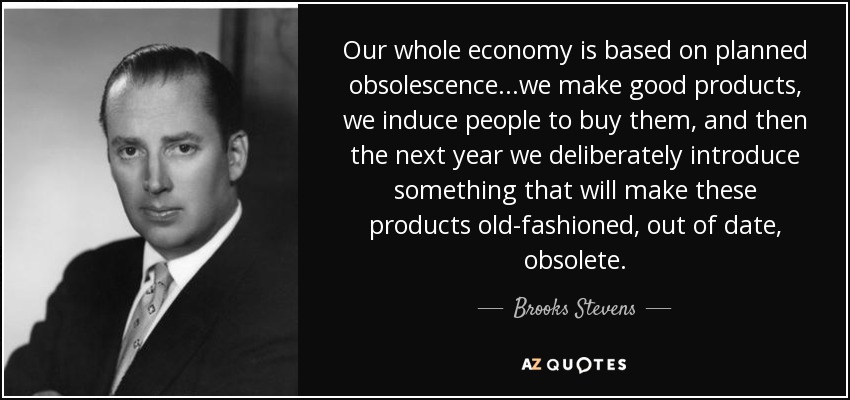
Daisy presented about planned obscelesence for her Pecha Kucha. Planned obsolescence has been around since about the 1920’s, when corporations started realising that they could make more money, not by spending more money, but rather making products that would only last a certain amount of time before the customer would need to replace it.

Stevens, B. (2019). QUOTES BY BROOKS STEVENS | A-Z Quotes. [online] A-Z Quotes. Available at: https://www.azquotes.com/author/32081-Brooks_Stevens [Accessed 23 Sep. 2019].

Company’s wanted to generate long term customer’s but they found that those who bought their products did not need to buy more of this product for a long time, meaning that the creation of long-term customer’s was difficult. A common example of this is nylon stockings, whereas before about the 1920’s these would last for a long time, now these stockings don’t last for long at all before they tear and women have to buy new ones.

The prevalence of planned obsolescence has contributed to our circular economy and throwaway culture. In order to prevent this we need to understand how technology, fashion, and other products are made so that we can choose to contribute to those who work within an ethical practice so that we can redefine the design process so as not to create so much waste.

Week 8 – Post-Digital

Uncategorized

This weeks topic is where history seems to catch up with us. We are currently living in the Post-digital era, where we are not amazed by the fact that many technologies exist, but are interested in how these technologies can take us into the future. We are not amazed by the technology, engineering and design that had to go into the flat-screen TV in our living room, or our mobile phone. We just accept that these items exist and are essential to our daily lives, often failing to consider how recent these inventions are. That is Post-Digital. We have passed the initial digital age when we were astonished by these digital technologies.

What we are now impressed by is the merging of the digital world with our own, in a way that changes our perspective. The popularity of Augmented reality demonstrates how individuals want to be able to have control over their own environment throughout he use of digital technologies. Whilst, Virtual Reality (VR) has caught the attention of many people around the globe as the idea of being transformed into a completely different environment attracts many individuals.

It could be said, that, whilst we are no longer in the original digital age, our own yearning for the next big thing has not decreased, but possibly increased. Even though we often take the technologies we use daily for granted, we still have a need to innovate to find ways that we can communicate better, or the truth we may not want to admit, is that we want to find more ways to disconnect from the world around us through the use of the next big thing as an excuse. Are we really just looking for ways to escape this place? Our current technological revolution is driven by the longing for an escape to a better place, and we want to make that place the best it can possibly be.

This can be seen through the post-digital art forms. Up until recently most art was viewed or experienced without escaping from the individual’s actual surroundings. Now, many artists are taking advantage of new technologies which allow them to provide an immersive art experience for their viewers. Artists such as Rachael Rossin are at the forefront of the merging of art and VR technology. Rossin creates digital artworks that are displayed through VR so that the viewer can fully immerse themselves in the viewing of the art.

Rossi, R. (2017). Scrubbing 1, Macquette. [image] Available at: https://www.artsy.net/artwork/rachel-rossin-scrubbing-1-maquette [Accessed 22 Sep. 2019].

We will continue to search for new digital solutions to problems we face, but because humans are forever amazed by the thought of escaping, there will always be new technologies that are created purely to entertain and transform our realities.

Week 7 – Evolution of the Computer

Uncategorized
Photo by Clément H on Unsplash

Computer’s have been around since the 1950’s, but not with any resemblance to the computer’s we know today. The first computer’s were used by scientists to store data from experiments. It wasn’t until the 1990’s that computer’s as a tool for sharing data became a reality. Before this, groups of computer’s had been connected to networks which meant that they could communicate with other computer’s on their network, however the concept of the World Wide Web or Internet had not been invented yet.

No one person invented the internet, but eventually all the technologies that were necessary for the invention of the World Wide Web had been invented and Tim Berners-Lee (World Wide Web Foundation, n.d.)had used these technologies in order to create the World Wide Web. This represented a turning point in communication as individuals were able to connect with individuals from anywhere in the World. This meant that a rapid increase in technology began as more people could collaborate on projects in order to reach new and different conclusions.

Now, we are still in a technological revolution as individuals are constantly creating new ways of working with computer technologies and the web.

Some of the most notable recent technologies are virtual reality and augmented reality. With these technologies the real and the fake become intertwined. Using the augmented reality app, ink hunter, I took the image below and shared it with some of my friends as though I had got a tattoo. My goal was to see if I could trick them into thinking I got a tattoo even though I haven’t. (I’ve never siad anything about wanting to get a tattoo so understandably they weren’t immediately convinced, but they were shocked and asked if I had actually got a tattoo.)

Image taken by Chalyse Fowler using ‘Ink Hunter’ app

I was surprised at how well the app placed the tattoo on my skin and it could definitely be useful if someone wanted to see how a tattoo would look on their skin. It was also cool to see how reality could be augmented with these technologies.

The evolution of the computer is extremely interesting and helps humans to create in more ways than ever before. However, it is important to realise, that no matter how technology increases, it is still up to us as human beings to create, technology will never be able to do this as effectively as we can.

Week 6 – Identity Design

Uncategorized

Publicity is something that no one can escape. Whether we want to accept it or not, we have all been influenced by publicity. Even if we don’t think that we’ve purchased anything as a direct result of a commercial, there is a high chance that we may have become more accepting of a product after being exposed to the product more often.

As humans, we can’t escape the influence that visual images have on us. Whilst it may not be glaringly obvious at first, each of these advertisements have been formed in a way that will have the biggest influence on us. Take Coca-Cola for example, without publicity, it would have just been a drink a chemist made in a lab, not the far-spread symbol of happiness that it is today. Through publicity, the team was able to present Coca-Cola as a drink that represented happiness for all those who drank it. This went further than just tv commercials smiling people drinking Coke. From slogans, to even the distinctive shape of the bottle, Coca-Cola made it’s way into the hands of millions. This would have been almost impossible without the publicity work done by many in presenting Coca-Cola in this way from the very beginning.

‘The evolution of the Coke Bottle’
https://www.chowhound.com/pictures/evolution-coca-cola-bottle-can-designs/original-coca-cola-bottles

Semiotics plays a massive role in identity design. In order for people to buy a product, they must first understand why they need it. This is where the role of the publicist is, they must present images in a way that subconsiously teach the consumer how the product will help them and why they need it.

Week 5 – The History of Photography and Design

Uncategorized

Photography has an interesting place in history. Somewhere between the painters and the designers it finds it’s place. A source of fear for many, a source of inspiration for others. All whilst still finding it’s own way in this complicated world.

Until the late 19th century, oil paint reigned. It represented prestige and power. It was an expensive task to have a painting done. Only those with riches and power could afford a likeness of themselves. Something that was not accessible to those below them. These likenesses also represented wealth for the artists. Most painters in the 19th century earnt a living through the painting of portraiture for the rich.

Photo by Clem Onojeghuo on Unsplash

Until, photography. with photography came the accessibility of images to a wider class. No longer did the rich feel a sense of dominance through an image of themselves. It was now a medium that so many others could access.

Same too for painters, who were highly concerned that their profession was about to become useless with the invention of the camera. No longer did the rich need a talented painter to complete a likeness, rather they just needed someone who could afford the camera. This caused a sense of fear amongst many painters, and they began to look for ways to differentiate their work from that of the camera.

This is, arguably, one of the times of greatest growth within the art of the paintbrush. Surrealism was largely grown from the need to thrive within a seemingly unthriveable environment. The works of John Baldessari in the 1960’s show how photography became a medium for painters to further develop their ideas, in a way that went beyond what painting had previously been able to do.

Martin Heiferman describes how ‘Photography, one might argue, didn’t murder painting; it shook things up by creating new options and opportunities.’ (Heiferman, 2010)

Photo by Rayan Almuslem on Unsplash

Photography was not initially considered to be an art form. It was seen as too mechanical and didn’t require enough creativity from the artist. As photography progressed and photographers found ways to express their creativity through the mechanics of the camera, it is now recognised more often to be an art form.